
If someone searches “accountant near Raffles Place” or “best dim sum Buona Vista” right now, your business either shows up, or it doesn’t.
That’s what local SEO decides. And in Singapore’s hyper-competitive market, being invisible online isn’t just a missed opportunity. It’s customers walking straight to your competitor.
This guide is for Singapore business owners who want to understand how local search actually works and what they can do about it, without wading through jargon or generic advice that could apply anywhere in the world.
What Is Local SEO, and Why Does It Matter in Singapore?
Local SEO is the practice of making your business easier to find when people search for products or services near them. That could be a Google search, Google Maps, or even voice search on a phone.
In Singapore, this matters more than in many other markets. The country has one of the highest smartphone penetration rates in the world, and most Singaporeans start their search for local businesses online before going anywhere. If your competitors have optimised their digital presence and you haven’t, you’re already playing catch-up.
Local SEO is different from general SEO. General SEO is about ranking a website for broad search terms. Local SEO is about showing up in a specific geographic area, your neighbourhood, your district, or the whole island, when someone nearby is ready to buy.
How Google Decides Who Ranks Locally
Before you start optimising anything, it helps to understand what you’re optimising for. Google uses three main factors when ranking local results:
Relevance: How well does your business match what the person searched for? This is driven by how clearly you’ve described your products, services, and business category.
Distance: How close is your business to the person searching (or to the location they’ve specified)?
Prominence: How well-known and trusted is your business, both online and off? This includes reviews, backlinks, and mentions across the web.
Getting these three right is the foundation of everything else in local SEO Singapore strategy.
Setting Up and Optimising Your Google Business Profile
Your Google Business Profile (GBP), formerly Google My Business, is the single most important asset in local search. It’s what powers the map pack (those three business listings that appear at the top of Google results).
Here’s what a strong GBP looks like:
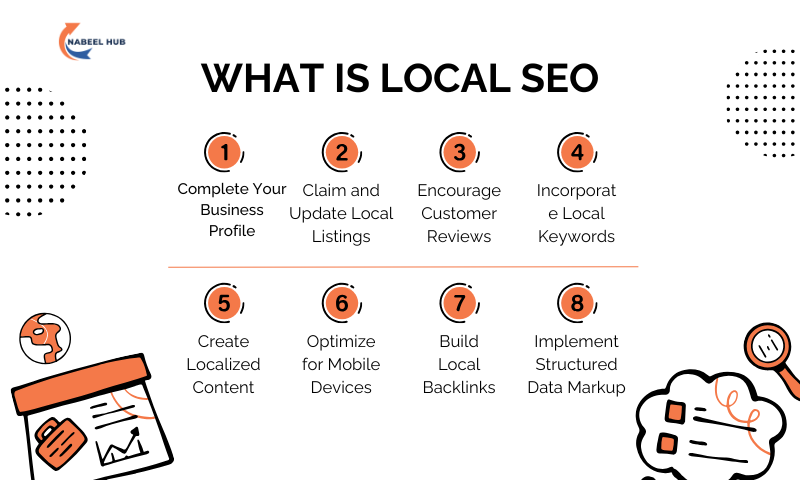
Complete every section. Business name, address, phone number, website, hours, categories, services, and a description. Don’t leave fields blank, Google uses all of this data to match your profile to searches.
Choose the right primary category. This is arguably the most important single decision in your GBP setup. “Restaurant” and “Chinese restaurant” are very different signals to Google. Be as specific as accurate allows.
Add real photos regularly. Listings with photos receive significantly more requests for directions and website clicks. Use actual images of your space, team, and products, not stock photos.
Post updates. GBP lets you publish offers, events, and news. Regular activity signals to Google that your listing is managed and current.
Respond to reviews – all of them. Positive, negative, somewhere in between. Your responses show potential customers how you operate and signal active engagement to Google.
Building Local Citations That Actually Help
A citation is any mention of your business name, address, and phone number (NAP) online. This includes directories, industry listings, social platforms, and news sites.
Consistency matters enormously here. If your address appears differently across platforms — “Jln Besar” on one, “Jalan Besar” on another, with different phone numbers — Google can’t be confident your listings are accurate. That uncertainty hurts your rankings.
In Singapore, the key citation sources include:
- Singapore Yellow Pages
- HungryGoWhere / Burpple (for F&B businesses)
- SingaporeExpats (for expat-facing services)
- Yelp Singapore
- Facebook Business Page
- Industry-specific directories relevant to your sector
Start by auditing your existing listings and fixing any inconsistencies before you build new ones.
On-Page SEO for Local Visibility
Your website needs to tell Google, clearly and naturally, where you operate and what you offer. Many Singapore businesses overlook this completely.
Use location-specific landing pages. If you serve multiple areas, say, Orchard, Jurong, and Tampines, each deserves its own page. These pages should speak directly to customers in that area, not just swap a suburb name into a template.
Add your NAP to every page. Usually in the footer. Make sure it matches your GBP exactly.
Use local language naturally. Singaporean English has its rhythms. If your customers say “air-con servicing” rather than “HVAC maintenance,” write how they search.
Embed a Google Map on your contact page. It’s a small signal, but it helps reinforce your location to both visitors and search engines.
Add schema markup. This is structured data you add to your website’s code to help Google understand your business type, hours, location, and more. It’s technical, but the impact on local visibility makes it worth doing. (Your web developer or SEO agency can handle this.)
Reviews: The Ranking Signal Most Businesses Ignore
In Singapore’s review culture, your Google reviews do double duty, they influence how customers perceive you, and they affect where you rank.
Google looks at three things: quantity, recency, and quality (including your responses).
You don’t need to game this. You need a consistent process for asking satisfied customers to leave a review. The simplest approach: a follow-up message with a direct link to your GBP review form, sent after a positive interaction.
Avoid fake reviews. Google detects patterns, competitors report them, and the reputational risk isn’t worth any short-term bump.
Local Link Building in the Singapore Context
Links from other websites to yours are still one of the strongest signals in SEO, locally and globally.
For local SEO in Singapore specifically, focus on:
- Local media coverage. Getting mentioned in outlets like The Straits Times, Business Times, or local blogs carries real authority.
- Industry associations. Many Singapore trade bodies and chambers of commerce maintain member directories with links.
- Sponsorships and community involvement. Events, charity drives, and local partnerships often earn legitimate links and genuine goodwill.
- Guest content. Writing useful content for Singapore-based publications in your industry can build both links and credibility.
Local links from relevant Singapore sources are worth far more than generic directory links. Aim for quality over quantity.
Common Mistakes Singapore Businesses Make With Local SEO
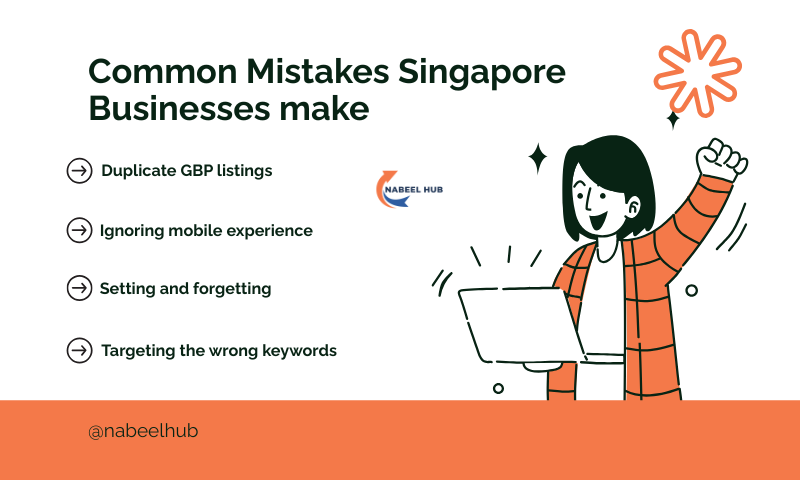
Even businesses that have taken local SEO seriously often undermine their own efforts. Watch out for:
Duplicate GBP listings. Multiple listings for the same business confuse Google and dilute your ranking power. Consolidate and verify a single authoritative listing.
Ignoring mobile experience. Most local searches happen on phones. If your site is slow or hard to navigate on mobile, you’ll lose the customers you worked hard to attract.
Setting and forgetting. Local SEO isn’t a one-time task. Businesses that stay competitive update their GBP regularly, respond to new reviews, and refresh their local content.
Targeting the wrong keywords. Optimising for “digital marketing” when your customers search “social media agency Bugis” means you’re competing nationally for traffic that doesn’t convert, instead of locally for traffic that does.
When to Handle Local SEO Yourself, & When to Get Help
For businesses with a single location, a tight budget, and time to invest, the fundamentals above are genuinely achievable without outside help. Set up your GBP properly, be consistent with citations, get reviews, and keep your website current.
But for businesses trying to outrank established competitors, those operating across multiple locations, or those in industries where local search is a primary acquisition channel — working with a specialist typically delivers better returns faster.
Nabeel Hub works with Singapore businesses across a range of industries to build local search visibility that compounds over time. Whether that’s through our local SEO services, AI-powered SEO strategies, or a broader engagement through our SEO agency in Singapore, we focus on results that matter, more qualified traffic, more enquiries, more customers.
You can also explore the areas we serve across Singapore to see if your location is covered.
Where Local SEO in Singapore Is Heading in 2025
A few shifts worth knowing about:
AI-generated search results. Google is increasingly surfacing AI-generated overviews at the top of search results. Businesses with strong local signals and clear, well-structured information are better positioned to be featured in these summaries.
Voice search. “Hey Siri, where can I get a good coffee near me?” These conversational queries favour businesses with complete, natural-language descriptions of what they offer.
Hyperlocal relevance. Google continues to refine how it matches searches to nearby businesses. Being specific about your location, down to the neighbourhood or even the building, can make a meaningful difference.
Reviews as trust infrastructure. The volume and quality of your reviews will matter even more as AI-assisted search surfaces business credibility signals more prominently.
None of these trends require a complete rethink of local SEO fundamentals. They reward businesses that get the basics right and stay consistent.
Conclusion
Local SEO in Singapore isn’t complicated, but it does require consistency, attention to detail, and patience. Most businesses underinvest in it, which is precisely why getting it right gives you a real edge.
Start with your Google Business Profile. Fix your citations. Get your reviews in order. Then build from there.
If you’d rather have a team handle the heavy lifting while you focus on running your business, that’s exactly what Nabeel Hub is here for.
FAQs
How long does local SEO take to show results in Singapore?
Most businesses start seeing measurable movement in three to six months, though competitive industries and areas may take longer. Local SEO builds momentum over time, the sooner you start, the sooner it compounds.
Is local SEO different for service-area businesses that don’t have a shopfront?
Yes. Google allows you to hide your address and define a service area instead. You’ll still need a verified GBP, and you should list the specific areas you serve clearly on your website and in your profile.
Do I need a Singapore-based website to rank locally?
Not necessarily, country of hosting matters less than it used to. What matters more is that your website clearly signals Singapore relevance through your content, NAP, and GBP connection.
Can I do local SEO without a website?
Your GBP alone can get you into the map pack, but a website significantly strengthens your overall local presence and gives Google more signals to work with. It’s worth having one.
What’s the difference between local SEO and paid local ads?
Paid ads (like Google Local Services Ads or Google Ads) give you immediate visibility but stop the moment you stop paying. Local SEO builds organic visibility that persists and strengthens over time. Most businesses benefit from both working together.
How important are photos for local SEO?
Very. Beyond their influence on ranking, photos directly affect whether potential customers click, call, or visit. Keep your GBP photos updated and representative of your actual business.
